Simple, Relational Acupuncture for the Whole Family .
Health is Always Present
People often come in with pain, stress, or fatigue. When symptoms keep returning, the body may be asking for a different approach. We work toward something deeper: steadiness, clarity, and resilience that lasts.

Honoring Pain Without Defining You by It
Many people find me while looking for help with things like:
For adults navigating midlife:
Hormonal and metabolic shifts
Chronic stress, anxiety, and burnout
Sleep issues
Chronic neck, shoulder, and back pain
Headaches and migraines
Digestive discomfort
Sports injury recovery and athletic performance support
For children:
Sleep issues
Digestive discomfort
Anxiety and big emotions
Puberty transitions
Recovery from illness
Your experience matters. Pain is real, and deserves care.
At the same time, I don't reduce you to a diagnosis or a condition.
Pain is often a signal—not the whole story.
“When you’re supported as a whole, symptoms often change in ways that feel both surprising and natural.”
Prefer to See Specific Conditions?
If you’re the kind of person who likes to see the specific conditions people often seek acupuncture for as an effective form of care, you may find it helpful to review a grounded, practical list.
What This Looks Like in Practice
My approach is quiet, precise, and relational.
Each session is 35–45 minutes of fully present, attuned care.
We don’t chase symptoms.
We create the conditions for regulation and healing to emerge.
This work is influenced by Japanese-style acupuncture and biodynamic principles, with the understanding that health isn’t created—it’s uncovered and supported.
You’ll leave feeling grounded, focused, and centered, ready to return to your life.
Who This Care Is For
This work is especially supportive for:
Adults carrying long-term stress or navigating midlife transitions
Parents who want to stay present and regulated
Aging athletes seeking recovery and performance support
Children with developing nervous systems
People who feel “mostly fine” but know something is off
Those seeking preventative, regenerative care rather than quick fixes
What to Expect
Sessions guided by careful listening and skilled touch.
Acupuncture one needle at a time, without retention.
More time built into the first visit to establish relationship and understand how your system has been adapting.
Care that evolves and deepens as your body settles and reorganizes.
“Effective care doesn’t need to feel overly clinical.”
Simple Pricing
Acupuncture Session — $110
Pediatric Session — $55
First visits include additional time, with the same pricing throughout.
Some employer wellness benefits may apply.

A Different Definition of Medicine
Acupuncture is a form of regenerative medicine because it supports the body’s natural ability to heal, balance, and function.
This is slow medicine in the best sense: attentive, efficient, and human.

“I have had a lot of experience with acupuncture and I have seen many skilled professionals on my healing journey, and there is something special about Jimmy. From my first appointment, I felt at ease. His gentle, soft spoken manner and superb listening skills, coupled with clear competence in his craft, makes for a powerful healing experience. His skilled, compassionate listening is truly a gift! I have felt safe, seen, and heard in every session.
I highly recommend Jimmy, especially for people who have a fear of needles or who may have had a negative experience with acupuncture in the past.”
~ Coach Michelle ~
“I highly recommend Jimmy and his Pediatric Shonishin Acutherapy Technique! He has seen both of my daughters (ages 7 & 4) a number of times since May of this year and they really enjoy going to their appointments. They actually ask when they get to see Mr Jimmy again! The treatment studio is complete with a comfortable seating area with natural elements and super fun toys, which are my daughters’ favorite, and a separate treatment room with a warm, heated table. My girls also enjoy requesting their preferred music to listen to during their treatments. Throughout the treatment, Jimmy is highly intuitive and gentle as my daughter guides which tools are used on what body part. Both girls now ask specifically for the “smoke stickers” and tell Jimmy where they want them placed. I have noticed great results from the treatments as well! My girls have more regular bowel movements, less mood swings, and are sleeping more soundly. They can’t wait for their next appointment! Thanks Jimmy!”
~ Caren T. ~
“My hands and wrists have never felt better!
3 months ago I couldn’t have imagined 5 more years in my career and now I haven’t felt any aches or pains since my 2nd appointment! Jimmy is very knowledgeable and has such a comfortable healing space, I highly recommend!”
~ Tedde B. ~
Additional context for those who like to look a little deeper
What happens when I arrive?
The clinic is located on the main floor at 412 S. Howes Street.
Across the parking lot you’ll see US Bank.
Parking directly in front of the office is reserved for the bank.
Please park in the rear lot, where parking is available.
Enter through the main floor entrance.
My office is the only door on the left.
If you arrive within a few minutes of your appointment, you’re welcome to come in, remove your shoes, and have a seat on the couch.
If I’m finishing another session, the treatment room door will be closed.
Please sit quietly, and I’ll be with you shortly.
It’s helpful to use the bathroom before your session.
The bathroom is also on the main floor—the door on the right.
The code is 8052.
What Is the Space Like?
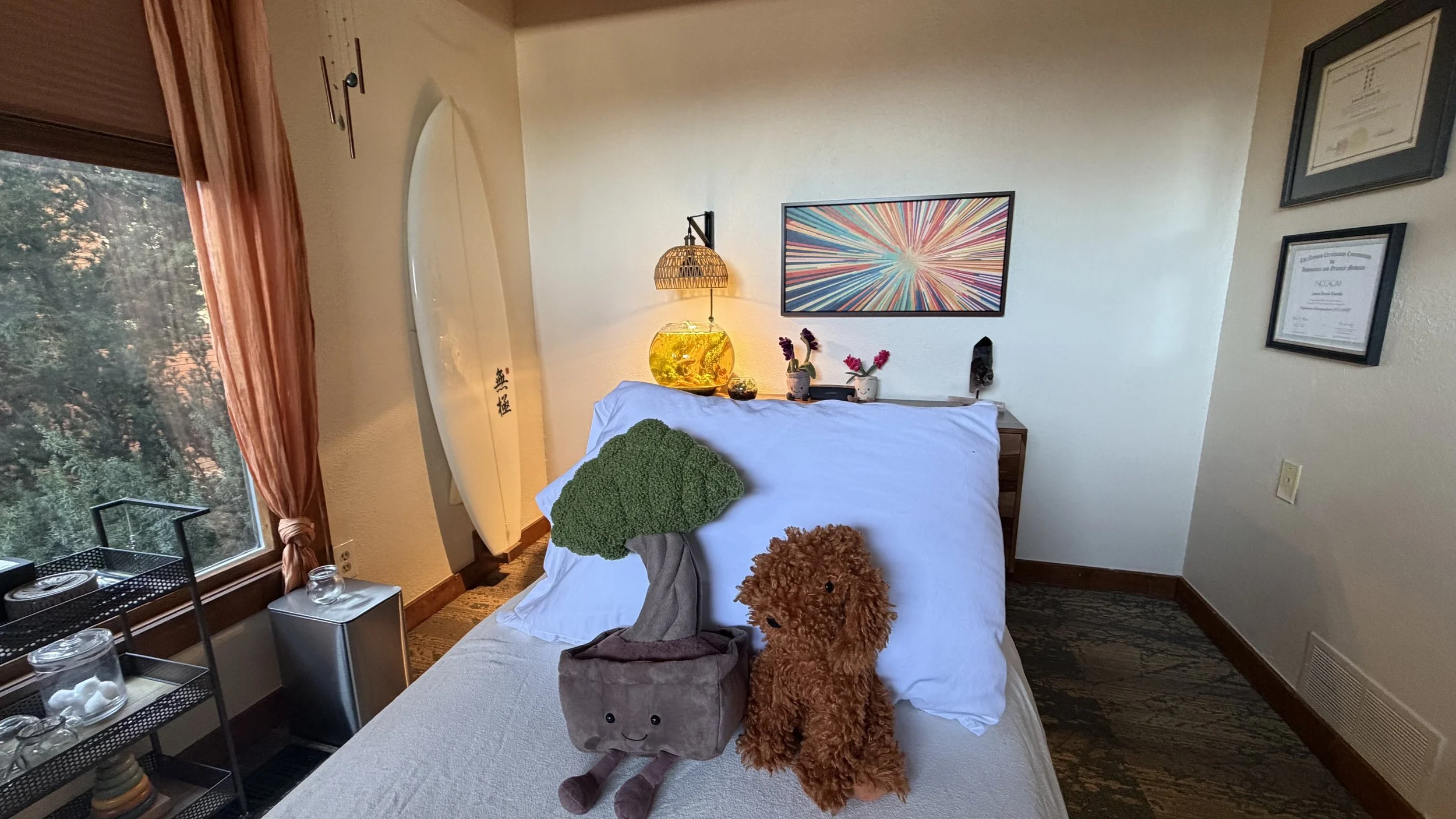
The treatment space is calm, quiet, and intentionally simple.
There are a few personal items that reflect my interests—a fish tank, a surfboard, a drum, and some paint brushes. You’re welcome to ask about them if you’re curious. Otherwise, the space is kept neutral and uncluttered.
Lighting is soft, or turned off when there’s good natural light. I don’t use fluorescent lighting.
Music is typically quiet piano. Occasionally I may be playing something I’m enjoying at the moment, and I’ll always check in if the music feels supportive for you.
I don’t use fragrance.
The only scents you may notice are moxibustion or topical liniments used during treatment.
If you have sensory preferences around light, sound, or touch, you’re welcome to let me know.
Do We Have to Talk a Lot?
No. We’ll talk enough to orient care, especially during the first visit.
After that, sessions are often quiet. At times, questions arise naturally through listening, touch, or subtle shifts in the body. I may ask something when it feels relevant, or invite you to notice or name an experience if it seems helpful. You’re always welcome to speak—or not—whatever feels supportive that day.
I’m present in the room for the entire session. Healing tends to work best in relationship, and staying together allows us to move at your body’s pace—pausing when needed, adjusting, or stopping when enough is enough.
Most sessions follow a gentle rhythm. We usually begin with some conversation, then gradually settle into quiet. There are a few intentional transitions—such as turning over or sitting at the edge of the table near the end—that help the body move back toward an alert, grounded state.
The aim is for you to leave feeling settled, present, and clear—not spaced out or dropped away.
What If I’m Nervous or Unsure?
That’s common. You don’t need to arrive calm or prepared.
The structure of the session is steady and predictable, and we move at a pace your body can tolerate. We begin with as much space as you need that day—talking, sitting quietly, or simply settling in.
I stay present throughout the session, and we adjust as needed. You can pause, shift, or stop at any point. There’s no expectation to relax or “do it right.”
The goal is for your system to gradually feel safe enough to settle, without forcing anything.
Why Isn’t There a Long Intake Before the First Visit?
I intentionally keep paperwork minimal before our first session.
Unless something is important to know right away—or we’ve already spoken briefly by phone—I usually ask for detailed intake forms after the first visit, not before.
There are a few reasons for this.
First, it’s important to establish a sense of safety and relationship before asking you to share personal information. People often open more honestly once they feel how the care works and whether it’s a good fit.
Second, the first session is about listening and orienting—not collecting every detail. We only go so deep initially, and a well-attuned first session doesn’t require a full history.
Finally, I want you to have agency. The first visit is a chance for both of us to feel out whether this care is right for you. If it is, I then provide a comprehensive intake that allows you to reflect and share thoughtfully, rather than rushing through forms before we’ve even met.
It’s entirely possible to receive a meaningful, well-attuned first session with very little information beyond what’s present in the room.
How Many Sessions Will It Take?
I don’t have a crystal ball, and I’m not trying to fix you like a car.
Bodies are complex, adaptive systems. Rather than asking “How many sessions will it take to fix this?” a more useful question is often:
“How many sessions will it take to see if we’re moving in the right direction?”
For many people, the first few sessions are about helping the body settle enough to begin receiving care. Around three sessions, the system often starts to relax and respond. By four or five sessions, we usually have a clearer sense of whether this approach is supportive and where things are heading.
Consistency matters. When sessions are spaced too far apart early on, we often end up repeatedly addressing surface-level inflammation or acute flare-ups—like using a fire extinguisher over and over. When care is more consistent, we’re able to move beyond those surface responses and work with deeper patterns.
Many people choose to work together for a season—often something like 10–12 sessions—before spacing care out. Over time, sessions may move to biweekly, monthly, or seasonal support.
My goal isn’t lifelong customers. It’s long-term relationships where care intensifies when needed and tapers as your system stabilizes.
We’re looking for meaningful, observable change—not guarantees. Paying attention to how your body responds is part of the process.
What Does Progress Look and Feel Like?
Progress in complex systems isn’t linear.
It’s okay if you don’t feel much after the first session.
It’s also okay if you notice clear changes. Both are simply information about how your body responds.
Outside of acute injuries (which should be evaluated medically first), people often arrive with a clear idea of what they want to work on. Sometimes that matches what the body is ready to address first. Sometimes it doesn’t. The body often prioritizes its own order of repair, and part of our work is paying attention to that.
Practically, there are a few things we often notice early on.
One is a sensation sometimes called hibiki—often described as a spreading, warming, cooling, or flowing feeling. Some people notice it right away. Others don’t feel much at first, and that’s normal. Sensitivity varies, and response can change over time. This is one reason I work one needle at a time and use a range of tools, including non-insertive techniques when appropriate.
Another possible experience is feeling temporarily worse before feeling better. As the body shifts, stored tension or irritation can surface briefly before settling. What matters is that you tell me what you notice. If symptoms don’t improve after that settling period, it tells me the treatment was too much—and that information helps guide care.
What we’re really tracking is not a single sensation or moment, but how your body responds over time. That response helps us understand whether we’re moving in a supportive direction and how to adjust as we go.
Do I Have to Commit to a Treatment Plan?
You’re not locked into a treatment plan or package.
I do ask for a commitment to the process, especially early on. When it makes sense, I recommend scheduling the first four to five sessions at a consistent time that works for both of us. This creates a rhythm your body can rely on and helps move beyond surface-level or stop-start care.
It’s okay if this commitment happens after the first or second session. I won’t push. But working with one foot in and one foot out is often unsatisfying for both of us, and progress tends to stall.
Those early sessions are also a chance to feel out whether this care is a good fit. If it is, we continue. If it isn’t, that’s okay—and we can talk about next steps.
The goal is meaningful and appropriate care for you not for me.
What Is Your Cancellation and Rescheduling Policy?
You’ll receive a reminder by email or text 48 hours before your appointment. I encourage you to choose the reminder format that’s helpful without feeling intrusive.
I ask for 24 hours’ notice if you need to cancel or reschedule. Please call or text me directly. My number is (970) 682-5229.
If you reach out, I won’t pressure you to keep the appointment. I’ll listen. Sometimes a cancellation is about needing space, processing the last session, or realizing something wasn’t the right fit. That information matters and helps guide care.
I also understand illness—yours or your family’s. If something comes up last minute, please contact me as soon as you can to reschedule. This happens in my family as well, and I’ll always give you as much notice as possible if I need to adjust.
My emphasis is on professionalism and relationship.
How Do I Pay?
When you book online, you’ll be asked to enter a card to hold your appointment. That card is not charged without your consent, unless there’s a breach of the cancellation policy.
At the end of each session, I’ll ask how you’d like to pay. You’re welcome to:
charge the card on file
pay with cash
or pay by check
Most people find keeping a card on file to be the simplest option, but the choice is always yours..